
Pentas: one-stop-shop for rotational moulding


)
Daan Buitenhuis
Communication


Developing and producing a plastic product requires more than just a good mould and a rotational moulding machine. At Pentas, engineering, mould construction, rotational moulding, finishing, assembly and quality control all come together under one roof. This allows us to guide the entire process from idea to end product.
That is what we call a one-stop-shop. Not because we offer as many different services as possible, but because all steps take place within one coherent process. For OEMs, this means short lines of communication, direct contact and one partner who oversees the entire production process.
Table of contents
A good rotational moulded product starts with development
A successful rotational moulded product begins before the first mould is even built. That is why, at Pentas, we start by mapping out the Program of Requirements. This covers not only dimensions and function, but also material choice, mechanical load, connection points, assembly, appearance, standards, traceability, service life and recyclability.
Based on these requirements, our engineers work on the product design. We look not only at what is technically possible, but also at how the product will be produced. Where needed, FEM calculations, risk analyses and other engineering tools are used to further optimise the design. FMEA, control plans and error prevention are also considered before series production begins. This means a product is not first drawn up and only later made production ready. Design and process are developed simultaneously.
Rotational moulding has its own design rules. Wall thicknesses, draft angles, radii, ribs, inserts and the flow of the plastic powder are just some of the many variables that influence the final product. A small change can affect stiffness, weight, cycle time and reproducibility. By making this assessment in-house, Pentas can determine at an early stage whether a requirement should be addressed through geometry, material, local wall thickness or another construction solution.
By keeping engineering and production close together, these choices can be made early in the development process.
CLAAS: less material without loss of function
A good practical example is the development of a fuel tank of more than 1,000 litres for CLAAS. The brief was clear: not simply making a tank, but reducing its weight without compromising stability.
With a targeted wall thickness distribution and a design that took load into account, the tank became 25 percent lighter. This project clearly shows why engineering and production are difficult to separate in a functional rotational moulded product. For this collaboration, Pentas was named Supplier of the Year 2019 by CLAAS.
In-house mould construction
Once the design is finalised, it is translated into the mould. Pentas builds these moulds in-house in Almelo. The rotational moulding moulds are made from solid aluminium.
We look beyond just the shape of the mould. Heat transfer, shrinkage, parting lines, venting, closures and how the mould is used on the rotational moulding machine also play an important role. Even a good product design can still become unstable if the mould is not properly worked out thermally or mechanically.
Our own milling department has eight milling machines, including 3-axis and 5-axis machines. The large 5-axis Fooke milling machine makes it possible to machine large mould sections from a single piece. This can significantly reduce machining time on suitable projects, sometimes even by half, while requiring less manual finishing.
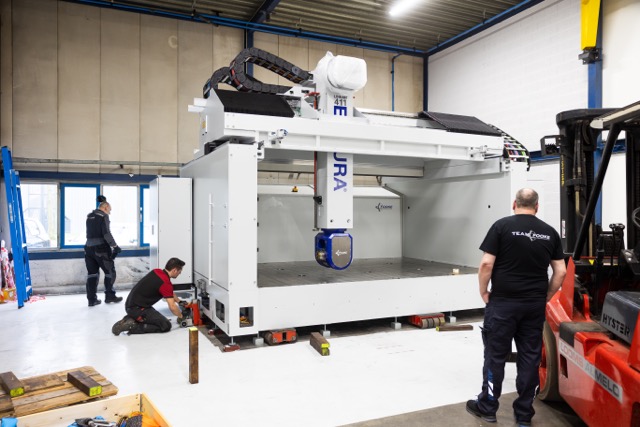
The greatest advantage of in-house mould construction is the short line between engineering, mould construction and production. If, during a trial run, it turns out that a radius, insert position or parting line needs adjusting, we can respond quickly.
Production on eleven rotational moulding machines
After development and mould construction comes the actual rotational moulding process. Pentas has eleven rotational moulding machines and experience with more than 1,500 different products. These products vary in size, from small items of around 500 grams and 100 × 100 mm to large products with a diameter of approximately 2,500 millimetres and a length of 4,000 millimetres.
Depending on the product and application, we work with various plastic materials, including different types of polyethylene, such as LLDPE, HDPE and cross-linked PE. We also process polypropylene where the application and process allow it. The right material choice depends on the requirements placed on the product, such as impact resistance, chemical resistance, temperature, stiffness, weight and service life.
Production is also becoming increasingly automated. Automation is used mainly where repeatability or workload requires it. Robots can weigh, dose and fill material, and are used for drilling, milling and gluing operations.
Automation does not replace craftsmanship. Operators continue to play an important role in process monitoring, machine changeovers and assessing products for deviations. The combination of people and robots is precisely intended to carry out repetitive steps more consistently, freeing skilled workers to focus on product and process quality.
An in-house laboratory for material and product
An important part of our one-stop-shop approach is our own laboratory. Here, we can not only assess a finished product, but also analyse the supplied material or powder and the molten material.
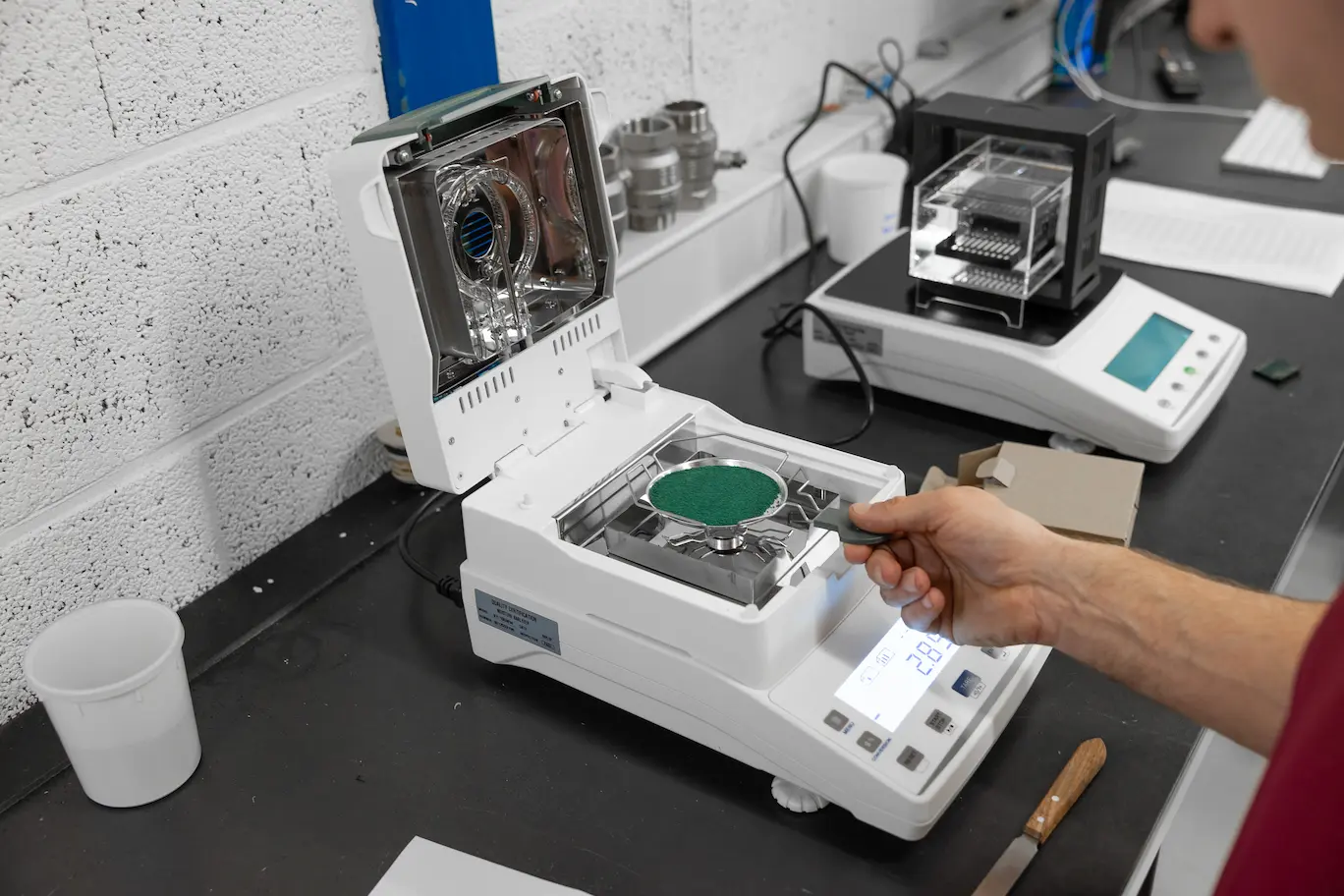
This allows us to analyse deviations in a targeted way. Does the cause lie in the raw material, storage or preparation, the temperature profile, processing, or the geometry of the product? That question matters more than simply establishing whether an end product does or does not meet the required dimensions.
Depending on the application, various tests can be carried out, such as compression tests, tensile tests, impact or mechanical load tests, temperature behaviour, chemical resistance, dimensional accuracy and leak tightness.
The knowledge from the laboratory is then used within engineering and production. In the case of a new raw material, a changed supplier or an unexpected product deviation, this allows for more targeted comparison and adjustment. For buyers, this reduces reliance on external laboratories for every initial analysis. For engineers, it results in a shorter learning cycle. External or accredited testing may of course still be required when a standard or customer specifies it.
Quality throughout the entire process
At Pentas, quality does not begin only once a product comes off the machine. The critical properties of a product are already determined and monitored during development and production.
During a First Article Approval, the first product is thoroughly checked against the agreed requirements. For complex geometries, 3D scanning can be used. Our HandySCAN setup can measure with an accuracy of up to 0.15 millimetres. The scan can then be used for first product inspections, series measurements and reverse engineering.
In addition, moulds, measuring equipment and digital GO and NO-GO checks are used where needed for the product.
Traceability also plays an important role. Products can, for example, be given a unique laser code. Available production and inspection data can be linked to this, such as weight, critical dimensions, leak test results and oven temperature. This allows us not only to check whether a product meets requirements, but also to look back at the production process whenever there is reason to do so.
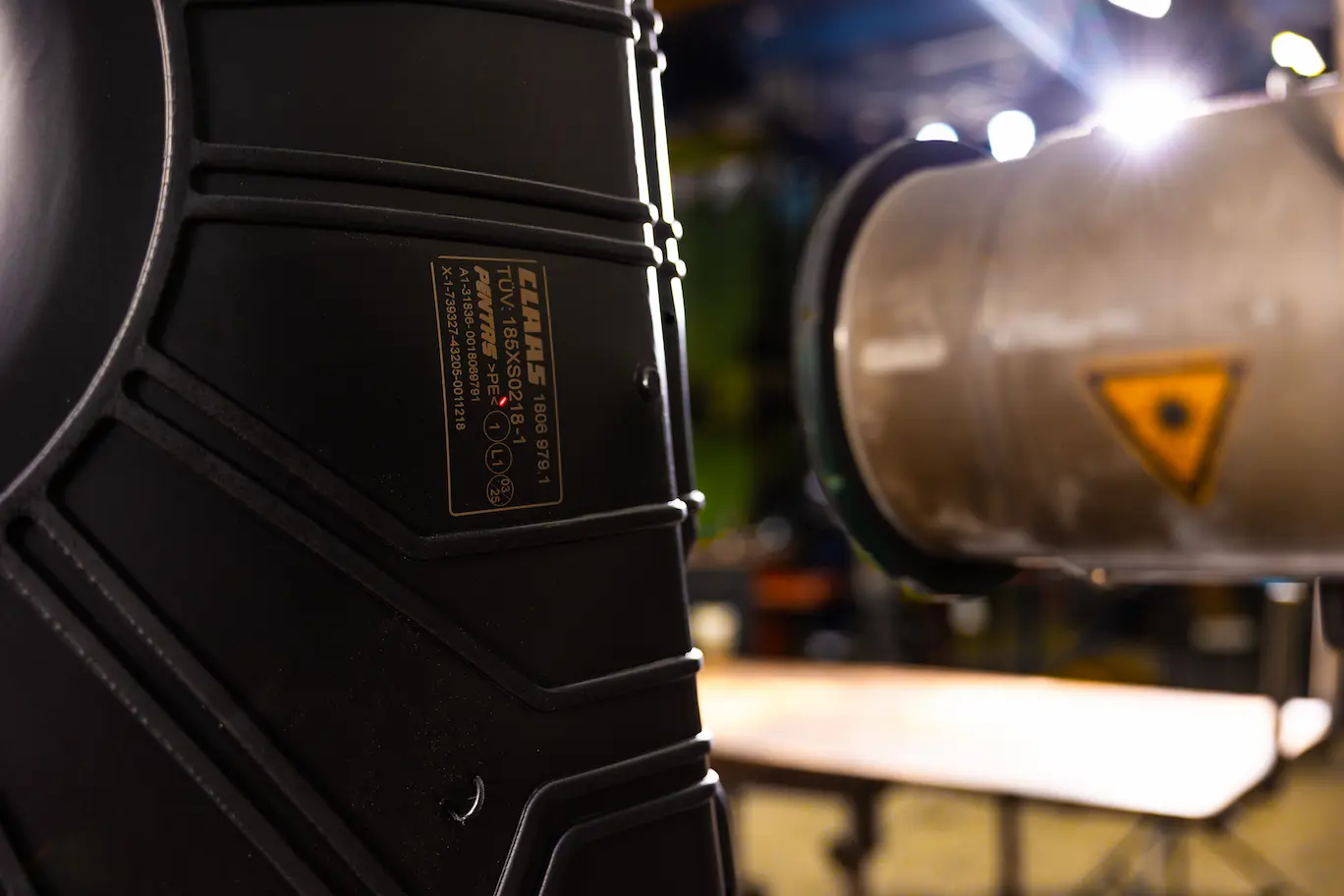
Not every product requires the same level of registration. Critical characteristics are determined based on risk and customer requirements. The system supports both release and investigation when a deviation is reported later. Pentas has worked according to an ISO 9001 certified quality management system for more than 25 years.
From plastic product to complete component
For an OEM, a rotational moulded product is often just an intermediate product. After rotational moulding, various finishing and assembly steps regularly follow. Openings are milled, inserts and connections are fitted, and parts are welded or glued. Components such as sensors, hoses, couplings, caps and fasteners can also be added.
Pentas carries out this work in-house. Foam filling is also among the possibilities, for example when insulation, buoyancy, sound damping or extra stiffness is required. We foam products using various foam systems, including PE, PU and PP solutions.
For the buyer, this shifts the nature of the purchased item: not a plastic shell requiring multiple follow-up orders, but a tested and assembled product at the agreed level. This can reduce stock, internal work preparation and the number of suppliers.
This trade-off must be made per product. Simple standard parts do not always need to be made by an integrated development partner. The added value arises mainly with products where design, process, components and quality assurance are genuinely interconnected.
From production to the production line
Logistics is also part of our one-stop-shop approach. We can deliver products just-in-time and, where the customer's production requires it, just-in-sequence. With just-in-sequence, not only is the right quantity delivered, but also in the order in which the OEM needs the products on the production line.
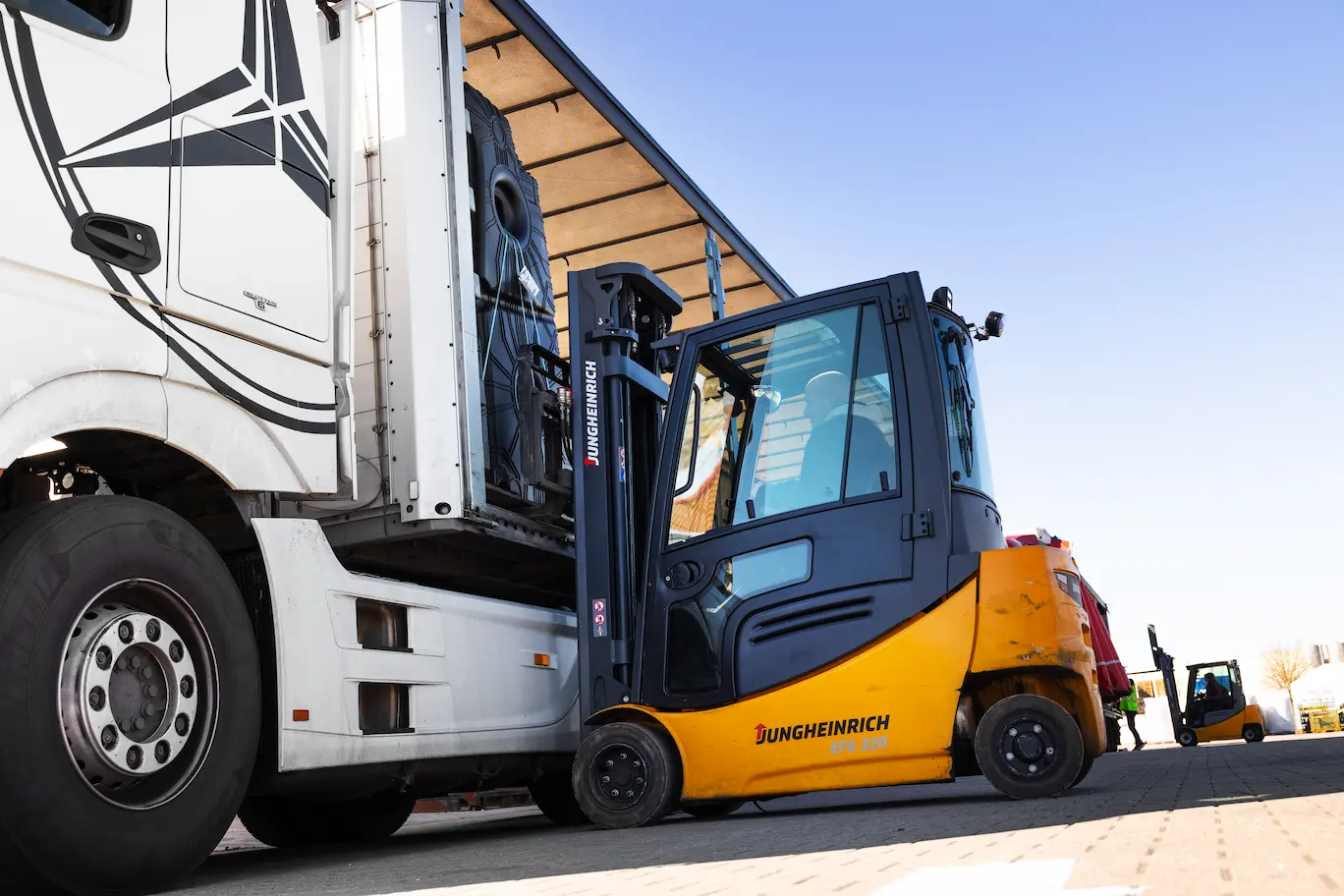
This requires reliable article data, EDI connections, production planning, packaging, identification and traceability. Logistics is therefore not a separate transport issue, but a continuation of the way the product and series are set up.
Collaborating on multiple products
Pentas prefers to focus on products with an off-take of roughly 300 to 100,000 units per year. Even better suited is a portfolio of multiple products or product families for the same customer.
There is a logical reason for this preference. With complex rotational moulded products, a great deal of knowledge goes into the initial product definition, material choice, mould, trial production, measurement method, automation and logistics setup. With a stable series, this investment can be leveraged over the product's service life. With multiple product families, knowledge, materials, components, measurement principles and logistics agreements can also be reused.
For the customer, a portfolio approach has a second effect: the supplier gets to know the platform, the assembly environment, the use and the quality expectations better. As a result, not every new component needs to be discussed from scratch. It also enables standardisation, for example in connections, inserts, raw materials, identification or packaging.
What kind of work suits Pentas best?
Pentas's approach is best suited to functional OEM plastic products with a clear function, a longer service life and sufficient repetition to recoup product and process development.
We produce a wide range of plastic products for various markets and applications, from agriculture and automotive to transport, logistics, construction, offshore, maritime applications and wind energy. We also develop and produce plastic solutions for recreation, consumer products and packaging. Examples include fuel tanks, air ducts, shields, technical housings, floats and various other plastic components. Products with complex connections, inserts, assembly, foam filling, critical dimensions or extensive traceability also fit well within our capabilities. Whether it concerns a simple product in large volumes or a complex technical product with specific requirements, we are happy to think along about a suitable and efficient product solution.
At the same time, rotational moulding is not automatically the best production technique for every product. For one-off projects with no follow-up, or very small series where the development effort is disproportionate to the volume, a different approach may be more suitable. For simple products and large series, rotational moulding can be particularly interesting. Thanks to our knowledge of automation, we can produce such products very efficiently. For example, we produced flowerpots in volumes of around 100,000 units per year, requiring hardly any manual labour. Products with a relatively low margin can therefore also be an interesting application for rotational moulding at high volumes. In some cases, blow moulding, injection moulding, sheet metal work or a composite construction may be a better fit for the desired volumes, tolerances, materials or shape. The value of a development partner lies precisely in making that assessment early on.
The strength lies in the connection between disciplines
Engineering, mould construction, rotational moulding, finishing and quality control are not unique in themselves. Other rotational moulding companies also have part of these capabilities.
What sets Pentas apart lies in the combination at a single location and in the feedback between the different steps. A laboratory analysis can lead to a process adjustment. A 3D scan can lead to a mould correction. An assembly issue can prompt a design change. A logistics requirement can lead to a different identification or packaging method.
These are short lines and fast feedback loops, rather than handovers between separate suppliers.
Technology in support of the process
In addition to craftsmanship, Pentas continuously invests in digitalisation and automation. Among other things, we are working on connections between ERP systems, machines, sensors and quality data.
Within an innovation project with Oost NL, for example, we are working on AI support for production planning and energy optimisation.
Technology is not a goal in itself. Ultimately, it is about the result: a more stable production process, lower energy consumption, better insights and reliable delivery to the customer.
One-stop-shop as a way of working
At Pentas, one-stop-shop does not mean that every customer has to take all possible services. It means that all the knowledge and disciplines needed to successfully develop and produce a rotational moulded product are available within one coherent process. Responsibility does not stop the moment the plastic part comes out of the mould.
For engineers, this means one development route in which material, geometry, mould and production are aligned with each other. For buyers, it provides the ability to manage total chain costs, risk and delivery performance. And for the OEM, it ultimately means one thing above all: a reproducible, tested and, where necessary, assembled product that can be delivered to the production line at the right moment.
The one-stop-shop approach comes into its own best with recurring series from around 300 units per year, and with customers who want to bring together multiple products or product families. Not because bigger is always better, but because Pentas can then apply the knowledge built up about application, material, production and logistics over a longer period.
This makes the term one-stop-shop not a marketing promise in itself, but a description of how we bring development and production together within Pentas.